The Odyssey (2026)
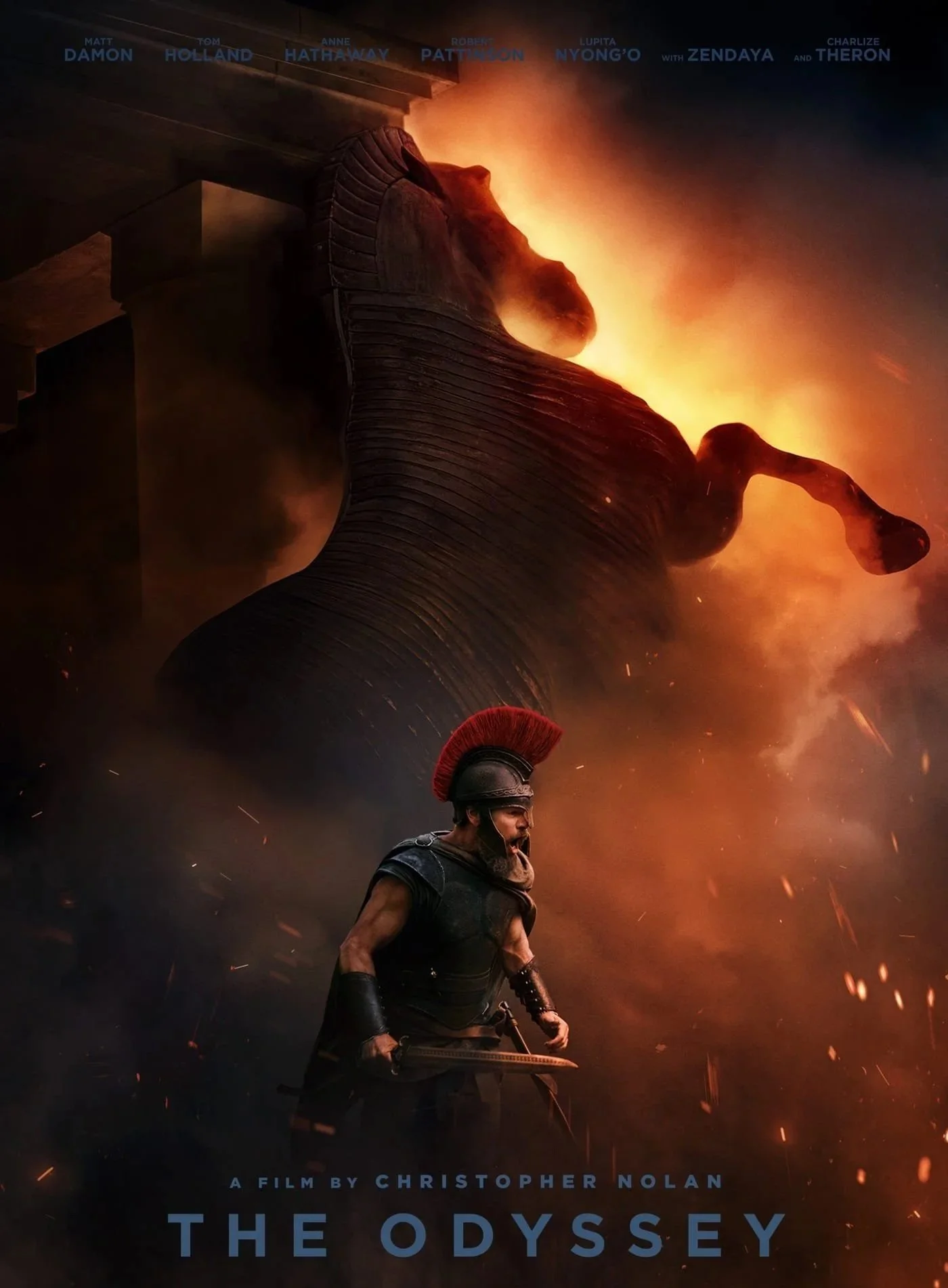
The Odyssey is perhaps Christopher Nolan’s most epic film so far – which is saying something. Nolan manages to walk the line between updating the ancient story for modern audiences while never losing any of its gravitas or weight, and also somehow manages to add a further layer of poignancy in the final act which recasts the 3,000 year old story in an entirely new light.

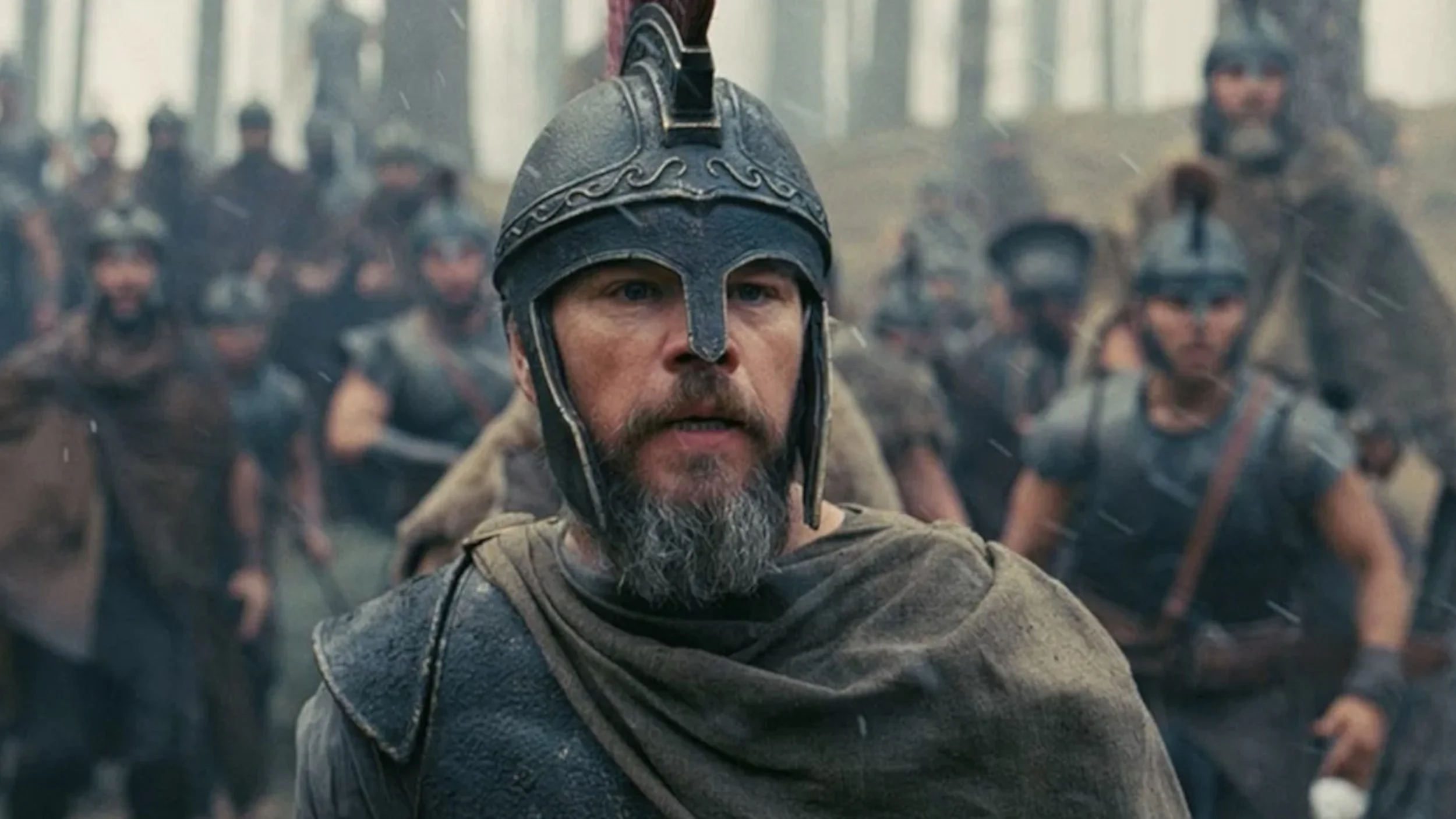
Premise: After the wooden horse ruse concocted by Odysseus (Matt Damon), King of Ithica, ends the Trojan War, the Greek armies set sail for their return journey home after 10 long years of war. But Odysseus and his crew find their journey home far from straightforward. Meanwhile, back in Ithica, Odysseus’ wife, Penelope (Anne Hathaway), and their son, Telemachus (Tom Holland), face dangers of a different kind as various suitors, including Antinous (Robert Pattinson), manoeuvre to take the throne of Ithica for themselves.
Review:
I’ll open by saying that not only do I love Greek mythology, but The Odyssey is probably my favourite of them all. I’m also a huge fan of Christopher Nolan’s films, many of which I consider to be masterpieces of modern cinema, and which have been my Film of the Year on several occasions. So it’s probably fair to say that The Odyssey ticked a lot of my boxes, and I went into it with very high expectations. Even with all that in mind, The Odyssey still somehow surpassed my expectations.
You could argue that it’s impossible to give away spoilers for a 3,000 year old story – but I think that Nolan’s adaptation contains some genuine surprises, so I’ll tread carefully. While the rest of the film is fantastic, the final act somehow finds an additional emotional gear which adds an extra layer of character depth and poignancy to everything that audiences thought they knew about Odysseus, the Odyssey and the Trojan War. This is very much a spiritual companion piece to Nolan’s Oppenheimer in terms of some of the themes it explores about human nature and mankind’s capacity for destruction.
“…the movie feels like a continuation of the oral tradition of storytelling…”
The Odyssey adopts a non-linear approach to its storytelling (a Nolan trademark), but in this instance, this approach suits the source material perfectly. The story is, by its very nature, very episodic, and in this adaptation many of the key events are shown to the audience when stories and memories are retold by characters onscreen, so that the movie itself feels like a continuation of the oral tradition of storytelling. So a character like Menelaus (Jon Bernthal) may tell the tale of the Trojan Horse, while a character like Eumaeus (John Leguizamo) may recount the first meeting between Odysseus (Matt Damon) and his hunting dog Argos. In this way, the audience slowly pieces together a picture of who Odysseus is through a series of retold stories, which perfectly fits the episodic nature of The Odyssey.
The other storytelling device that works really well is balancing the twin narratives of Odysseus’ journey home and what’s happening in his absence back in Ithica. I have seen versions of The Odyssey where the events back in Ithica are only shown to the audience in the final act, but here, the focus is constantly switching back and forth between Odysseus’ ordeals and the dangers that Penelope (Anne Hathaway) and Telemachus (Tom Holland) are facing without him. This not only means that Anne Hathaway and Tom Holland (and, for that matter, the other actors involved in the Ithica storyline, like John Leguizamo, and Robert Pattinson as the duplicitous nobleman, Antinous) get a lot more to do, but it also adds more context to Odysseus’ storyline in terms of what he’s left behind, and the consequences of his actions.
“…delivers huge action set-pieces & epic adventure…”
This film is a brilliant character drama (certainly as rich and complex as Oppenheimer was), with all of the main cast giving incredible and layers performances. As well as those I’ve already mentioned above, Elliot Page also appears in a small – but surprisingly pivotal – role as Sinon, one of the soldiers who accompanies Odysseus to Troy, while Samantha Morton is also excellent as the morally ambiguous Circe. Such is the appeal of working with Christopher Nolan, that even relatively small roles are filled by the likes of Charlize Theron, Lupita Nyong'o, Himesh Patel, Corey Hawkins, Mia Goth, Logan Marshall-Green, James Remar and Benny Safdie.
But unlike Oppenheimer, The Odyssey also delivers huge action set-pieces and epic adventure alongside the character drama. Nolan’s insistence on doing as much as possible in camera with practical effects means that no matter how fantastical the action is, it always feels grounded without the feintest whiff of greenscreen. The sequences on the sea were filmed at sea, and even fantastical sequences (like the Cyclops’ cave, and the journey into Hades) were filmed on location, given them a physical, tangible quality.
“…balances the mythological with the more grounded elements…”
Nolan also cleverly balances the mythological with the more grounded elements, so that although we have encounters with mythical creatures like the Sirens and the aforementioned Cyclops, we don’t see the gods directly interfering from Mount Olympus like we did in films like Clash of the Titans or Jason and the Argonauts. Instead, the only god we see in person is Athena (Zendaya), and even then, we only see her through Odysseus’ eyes when she appears to him. Cleverly, the presence of the other gods is only felt through their interactions with the “real world”, be that by causing storms and other incidents, or indirectly though the adoption of “Zeus’ Law”, which is intended to avoid mortals causing unintended insult to strangers who may be gods in disguise.
Similarly, I know some people bumped up against the accents when the first trailer dropped, but having the cast talk in American accents is a deliberate (and effective) choice. Firstly, it’s worth bearing in mind that an American accent is no less authentic for Ancient Greek characters that an English accent – despite most films having you believe that all ancient civilisations spoke in Received Pronunciation. If you’re not going to have characters speak in authentic Ancient Greek accents, an American accent is no less appropriate than any other.
“…another masterpiece of modern cinema from Christopher Nolan…”
But more importantly, Nolan doesn’t want to portray The Odyssey as a dusty relic, only of academic interest to classics students – he appreciates that at the time it was created, it was intended to be the blockbuster entertainment of its day, and he adapts it accordingly. So while it’s thematically rich, emotionally poignant and character driven, it’s also extremely accessible, with characters speaking in modern accents and using modern colloquialisms. The messages and themes of Nolan’s adaptation are universal – and some could argue, timely – and he clearly didn’t want those to become lost behind a facade of archaic language and contrived accents.
The end result is a film that combines the blockbuster appeal of Nolan’s earlier films like Inception or The Dark Knight, with the character depth and examination of humanity that Nolan showcased in Oppenheimer. The action is epic (especially if you get to see this in IMAX), but it’s the character moments that lingered after the end credits – making this a film that offers plenty for the head as well as the heart. All in all, it’s another masterpiece of modern cinema from Christopher Nolan.