The Hunger Games: Sunrise on the Reaping

While it goes without saying that the sixth movie in the series would not be the best jumping on point for new viewers, for everyone else, this is another gut-wrenching and thought-provoking return to Panem, for a prequel which offers a new perspective on the origins of the rebellion against President Snow.

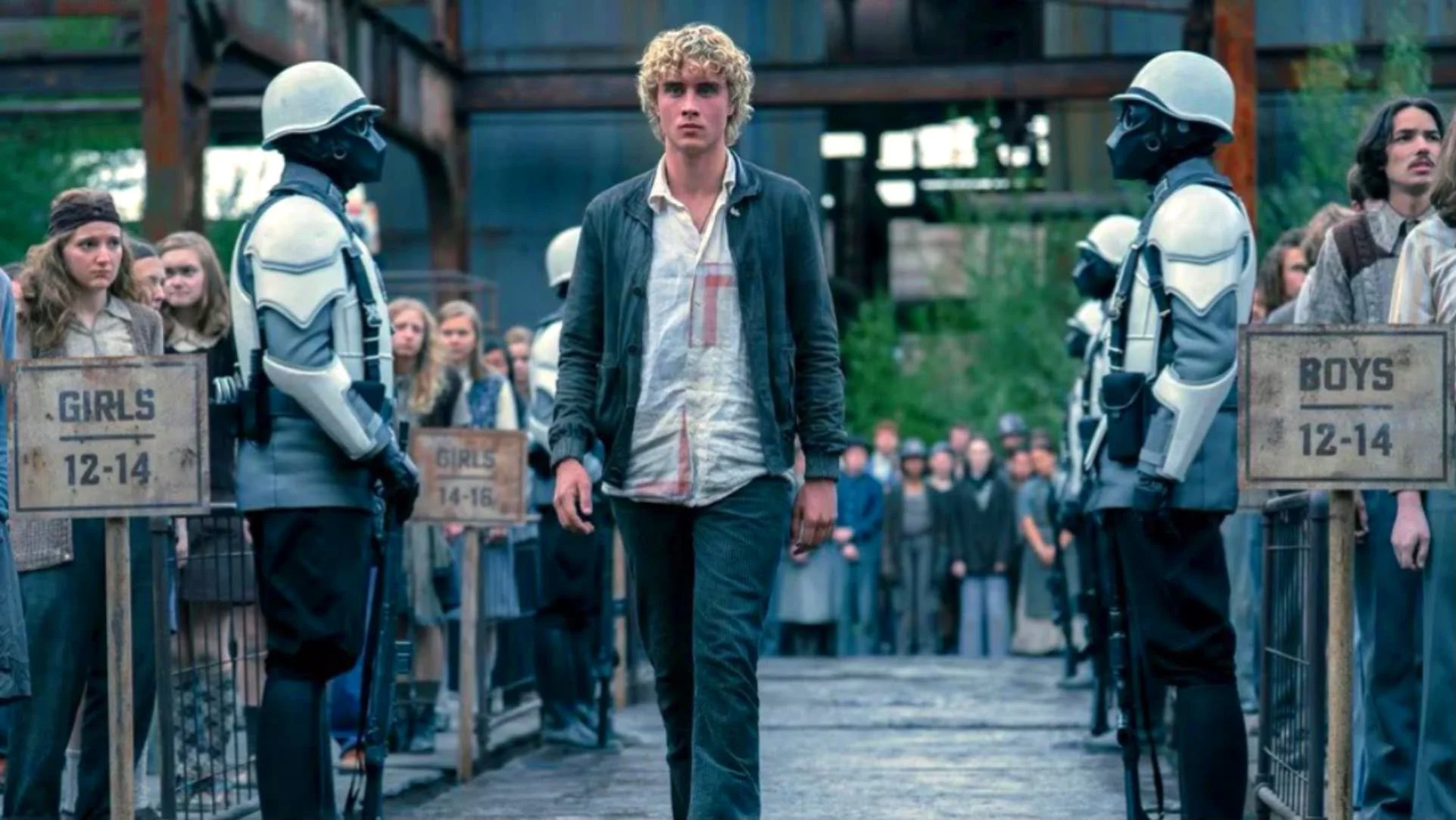
Premise: For the Fiftieth Hunger Games (which take place 24 years before the events of the original film), President Snow (Ralph Fiennes) decrees that there will be twice the number of Tributes draw from the Districts and forced to fight to the death in the arena. When 16-year-old Haymitch Abernathy (Joseph Zada) finds himself selected as one of District 12's Tributes, he catches the eye of television director Plutarch Heavensbee (Jesse Plemons), and becomes determined not to let the Capitol use his blood to paint their poster.

Review:
I am a huge fan of the original Hunger Games films that came out between 2012 and 2015 (Catching Fire even came sixth in my Top Fifty Films of the 2010s), and I also thoroughly enjoyed the 2023 prequel movie, The Ballad of Songbirds & Snakes. Series author Suzanne Collins and returning director Francis Lawrence (who are both back again for this film) did such an excellent job with that first prequel, that I had no concerns going into The Hunger Games: Sunrise On The Reaping that this second prequel wouldn't also live up to the high standards of the previous films.
Sunrise on the Reaping is arguably a more 'traditional' approach to a Hunger Games story than the first prequel was, following a protagonist Tribute (in this case, Joseph Zada's Haymitch Abernathy) from selection at the Reaping, through training, and on to competing in the Games, in the same way that the first two Hunger Games movies did with Katniss Everdeen. But this is certainly not a criticism, because Sunrise on the Reaping still manages to add something meaningful to the fictional history of Panem, even if it's not quite as 'outside of the box' in terms of its structure as The Ballad of Songbirds & Snakes was.
“…ties into, and enhances, the plot threads originally introduced in ‘Catching Fire’…”
Without wishing to get into spoilers (even if the novel has been out for some time, and a lot of Haymitch's backstory was also previously discussed in the original Hunger Games films), what makes Sunrise on the Reaping more than 'just another' story about a Tribute trying to survive the Hunger Games is the way in which it ties into, and enhances, the plot threads that were originally introduced in The Hunger Games: Catching Fire. I'm going to assume that if you're reading this, you've at least already seen the original four movies (otherwise, beware spoilers!), and I have to say that Catching Fire is probably my favourite of all of the Hunger Games movies. Don't get me wrong – I don't think there's a weak film in the series, and there's perhaps only a hair's breadth between them in terms of quality – but Catching Fire holds a special place in my heart because it was the film which really showed me the series' true potential. Up until then, I saw the first film as an (excellent) dystopian thriller about Katniss' ordeals while surviving in the Games, but Catching Fire was the film that really expanded that story onto a much larger canvas, weaving Katniss' personal acts of defiance into the wider narrative of a full-blown rebellion.
The key figures in that rebellion (at least as far as Catching Fire was concerned) were Plutarch Heavensbee (played by Philip Seymour Hoffman in the original films), the Head Gamemaker who was secretly a double-agent for the resistance, Beetee Latier (played by Jeffrey Wright in the original films), the former-Victor-turned-Tribute who devised the plan to disable the arena's forcefield, and Haymitch Abernathy (played by Woody Harrelson in the original films), the Mentor who coordinated the plan to free Katniss from the Capitol's control. Sunrise on the Reaping explores the previously untold story of how these key figures in the revolution first came to know each other, and how the seeds of rebellion first took root.
“…once again, there’s more to the story than just trying to survive…”
I won’t go into much more detail (plot-wise) than that, but suffice to say that, like Catching Fire before it, there’s more to the story in Sunrise on the Reaping than a simple tale of Tributes trying to survive the Hunger Games. And unlike the first prequel (which took place 64 years before the original Hunger Games movie), Sunrise on the Reaping is only set 24 years before the first film, meaning that as well as younger versions of Haymitch, Plutarch (now played by Jesse Plemons) and Beetee (now played by Kelvin Harrison Jr), we’re also introduced to younger versions of the Victors Wiress (originally played by Amanda Plummer, now played by Maya Hawke) and Mags (originally played by Lynn Cohen, now played by Lili Taylor), the Capitol citizens Caesar Flickerman (originally played by Stanley Tucci, now played by Kieran Culkin) and Effie Trinket (originally played by Elizabeth Banks, now played by Elle Fanning), and of course, President Snow himself (originally played by Donald Sutherland, now played by Ralph Fiennes). All of the actors playing returning characters do a fantastic job of making their characters recognisable, while also making them feel like three-dimensional people in their own right rather than an impression of the previous actors’ performances.
In terms of new characters, an almost unrecognisable Glenn Close plays Drusilla Sickle, Effie’s predecessor as the Capitol escort for District 12, and Whitney Peak makes a big impression with her limited screentime as Haymitch’s girlfriend, Lenore Dove Baird (who, in a nice piece of connected lore, is from the same Covey that Lucy Gray Baird was a member of in The Ballad of Songbirds & Snakes). Haymitch’s fellow District 12 Tributes include Mckenna Grace as Maysilee Donner, Ben Wang as Wyatt Callow, and Molly McCann as Louella McCoy, and they’re later joined by other Tributes, including those played by Laura Marcus, Iona Bell and Percy Daggs IV.
“…every member of the cast does a phenomenal job…”
One of the key strengths of the Hunger Games series has always been the depth of talent in its ensemble casts, and Sunrise on the Reaping is certainly no exception. Whether they’re playing younger versions of familiar characters, or new characters introduced in this film, every member of the cast does a phenomenal job of bringing nuance and pathos to their roles. Veteran cast members, like Jesse Plemons and Ralph Fiennes, are as excellent as you’d probably be expecting, but I’d like to single out the performance of relative newcomer Joseph Zada, who is superb at channelling the spirit and energy of a young Woody Harrelson, but without ever slipping into caricature, and who also ably portrays Haymitch’s descent from a (relatively) idealistic young man to the traumatised alcoholic we first meet in the original film.
The Hunger Games films have always been blockbusters with a real message at their heart, touching on themes like the cost of violence, trauma and PTSD, dehumanisation and othering, and the subtle seduction of authoritarianism, and Sunrise on the Reaping is no less a powerful movie. It shows that small acts of defiance by seemingly unimportant people can grow into an effective resistance to authoritarian rule, and it also shows that the rebellion seen in Catching Fire and The Hunger Games: Mockingjay was, in fact, 25 years in the making. In much the same way as Andor explored the grassroots origins of the Rebel Alliance that would eventually overthrow the Galactic Empire in Star Wars: Return of the Jedi, this film explores the genesis of the underground resistance that would one day lead to the abolition of the Hunger Games and the end of the Capitol's regime.
“…one of the most consistently strong, yet consistently overlooked, film franchises…”
In short, if you enjoyed the other Hunger Games films, then there's plenty to enjoy in this prequel, which adds yet more depth and detail to the fictional history of Panem – but if you've never seen any of the other films, this isn't an ideal place to start. If you've previously written these films off sight-unseen because of their 'Young Adult fiction' label, I urge you to reconsider, as these are far more nuanced and thought-provoking that you might imagine. They have also never been aimed at younger audiences, and Sunrise on the Reaping is certainly just as violent and brutal as previous instalments, establishing early on that the threat of a drawn-out, tortured, painful death is something which scares even those characters who have resigned themselves to dying a violent death.
This latest instalment is a must-see for fans, and it also reinforces the series' status as one of the most consistently strong, yet consistently overlooked, film franchises of the last two decades. And longtime fans (like myself) are also likely to find the movie's coda particularly affecting.