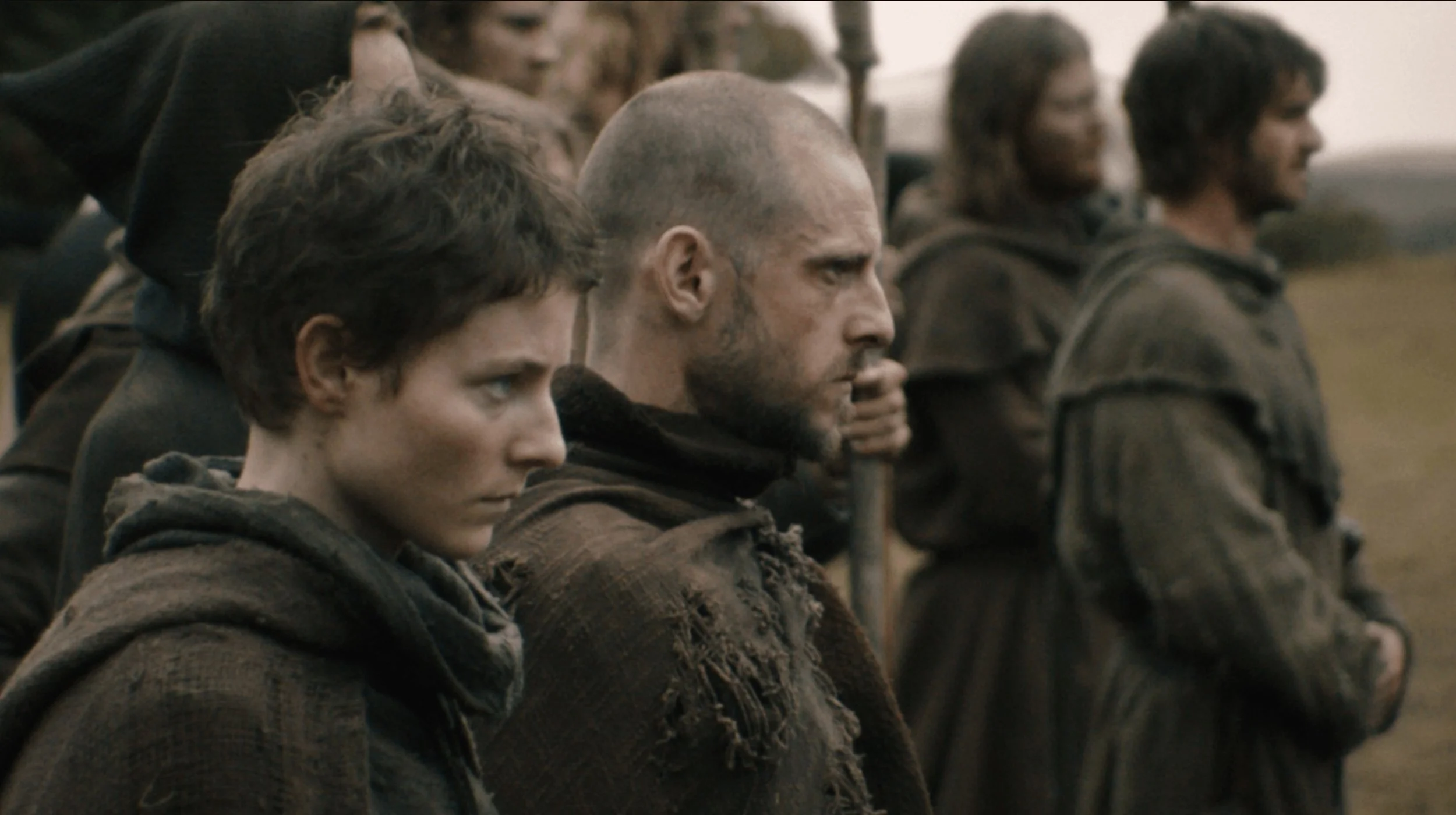
The Uprising
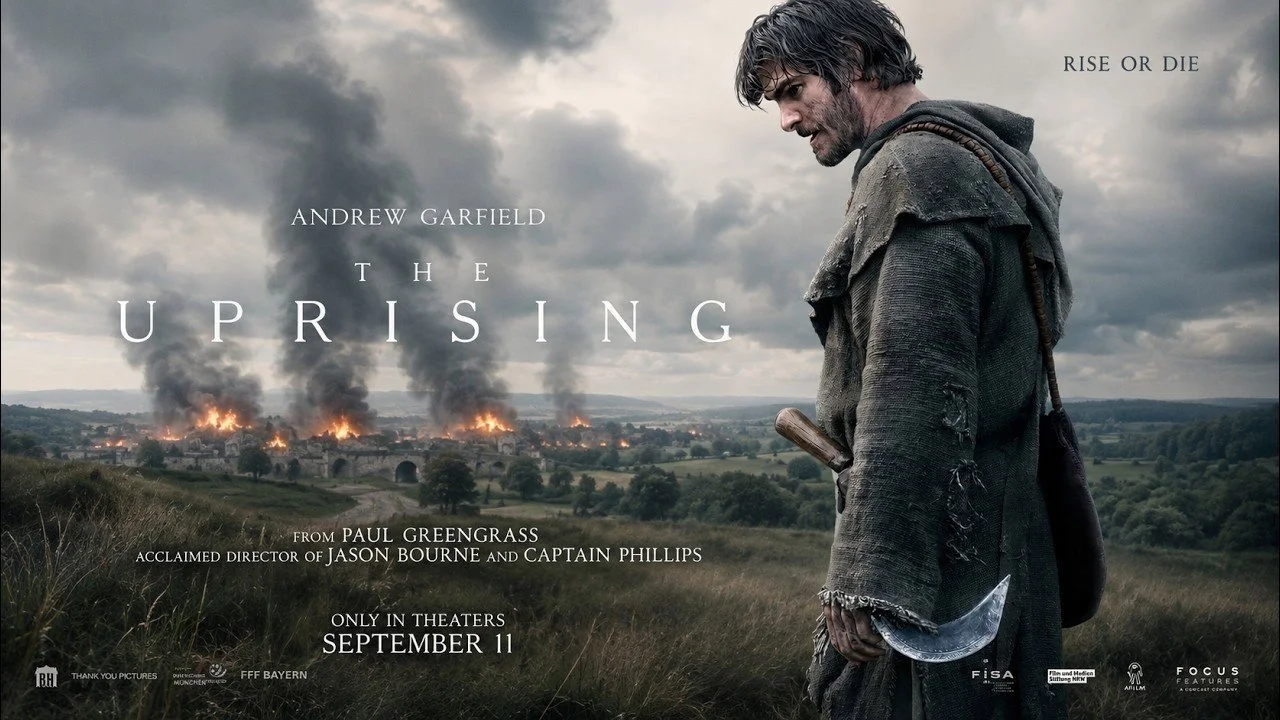
Director Paul Greengrass cleverly dramatises the 1381 Peasants’ Revolt in a way that draws clear parallels to today’s social injustices, while never losing sight of being an entertaining historical action drama rather than a lecture. Andrew Garfield’s emotionally restrained performance brings a human perspective to events, and conveys the barely contained rage at the exploitation of the ordinary people by the wealthy and self-serving elites.

Premise: England, 1381: in the aftermath of the Black Death which killed half the country’s population, England is ruled by 14-year-old King Richard II’s (Woody Norman) Council of wealthy nobles, church officials and judges. In need of more funds for the Hundred Years’ War with France, but unwilling to tax the merchant classes for political reasons, the Council introduce additional taxes on the already destitute peasantry. When an unnamed Ploughman (Andrew Garfield), still grieving the deaths of his wife and children in the plague, reaches breaking point, he joins former soldier Wat Tyler (Cosmo Jarvis) and egalitarian priest John Ball (Jamie Bell) on a march to London to petition the King.

Review:
I’ll confess that before seeing this film, I had no real knowledge of what the Peasants' Revolt was, other than having heard it referred to as a historical event from the Late Middle Ages (and that’s despite the fact that I studied History to A-Level!). I therefore only had a very vague idea of where The Uprising was going, and although the first half played out broadly as I was expecting, events in the final act in particular developed in ways I had not expected. With that in mind, I’m approaching this review as I would any other, attempting to avoid any major spoilers, even though the film is based on real life events that happened over 600 years ago.
Although writer/director Paul Greengrass has tackled real life events many times in the past (with United 93 and Captain Phillips being probably his best-known work outside of his Jason Bourne films), his films have all been (fairly) contemporary, and he’s certainly never done something as “period” as a story set in 1381 England. So you could be forgiven for asking: what drew Paul Greengrass, a director known for addressing of-the-moment political and social issues, to make a film about disgruntled farmers in medieval England?
“…Andrew Garfield delivers one of his best performances so far…”
Of course, the answer is that, like most great historical or period dramas, The Uprising is just as much about today’s society as it is about the politics of 1381. The film is set in a world still dealing with the aftereffects of a deadly pandemic, where the so-called leaders are so far removed from the struggles of ordinary people that they’ve lost sight of the impact that their economic policies are having on peoples’ lives, and where the self-serving wealthy elite have bought their way into power and will now do anything to hold onto it, no matter the cost that their corruption and greed have on the lives of everyday people. When you say it like that, perhaps it’s not that difficult to see why Paul Greengrass thought that now was the perfect time to bring the Peasants’ Revolt to the big screen.
As he often does, Paul Greengrass has assembled a great cast for The Uprising (which is all the more impressive given the film’s comparatively tiny $20m budget). Andrew Garfield carries the film as one of the few invented characters in the story, playing the unnamed Ploughman, through whose eyes the audience experience the historical events unfolding. Andrew Garfield has a tricky job balancing the need to bring Ploughman to life, while ensuring that his (fictional) character doesn’t overshadow the actual historical figures, at the same time as conveying the character’s internalised grief over the death of his family and rage at the injustices inflicted upon everyone, at the same time as keeping his character accessible to modern audiences coming to this film with no pre-existing knowledge of these historical events. Thankfully, Andrew Garfield is more than up to the task, and he delivers in this film what I think may be one of his best performances so far.
“…Tom Hollander & Stephen Dillane both play suitably hissable villains…”
Cosmo Jarvis and Jamie Bell have to stay within established parameters a little more as the real-life leaders of the rebellion, Wat Tyler and John Ball, but both manage to bring their characters to life: Cosmo Jarvis brings a soldier’s bluntness and pragmatism that is tempered with naivety to his performance, while Jamie Bell’s priest is more radical and risk-taking, while always being motivated by the needs of others and the realisation that this may well be a once-in-a-lifetime opportunity. Thomasin McKenzie also appears as Alyce, another invented character who acts as a sounding-board for, and an emotional contrast to, the Ploughman on their march to London.
The royal Council is led by Tom Hollander’s noble, Sir Robert Hales, and Stephen Dillane‘s Archbishop of Canterbury, Simon Sudbury, who are both suitably hissable villains – while Woody Norman plays the 14-year-old King Richard II, who appears to be little more than the puppet of his Council, crippled by insecurities and nightmares. Katherine Waterston plays the King’s mother, and gives a performance that hints at her wisdom and empathy that is an untapped resource that is completely ignored by the males in power. Rounding out the royal court is an almost unrecognisable Jonny Lee Miller as the Mayor of London, William Walworth.
“…a story that deserved to be told, and a movie that deserves to be seen…”
Given my lack of knowledge about the Peasants’ Revolt, I’m obviously unable to comment on the historical accuracy of The Uprising – although from what I’ve read after watching the film, I get the impression that, for a dramatisation, it’s fairly faithful to the actual events. As I said, I didn’t know where the events in the final act were going to go – and even if you do know how the Peasants’ Revolt ended, the film ends with a fictional epilogue, so there will still be some surprises for you. I personally felt that the fictional epilogue gave the film the emotional and narrative closure that the film (as a piece of entertainment, rather than a historical documentary) needed, but I appreciate that others may feel differently.
All in all, this was far better than I was expecting, and the fact that it’s based on actual historical events of which I was largely unaware, only made this more of an enjoyable surprise. Don’t go expecting the highs of something like Ridley Scott’s Gladiator, but equally, this is a far better and more entertaining film than something like Ridley Scott’s Napoleon. A story that deserved to be told, and a movie that deserves to be seen.