Avatar: Fire and Ash
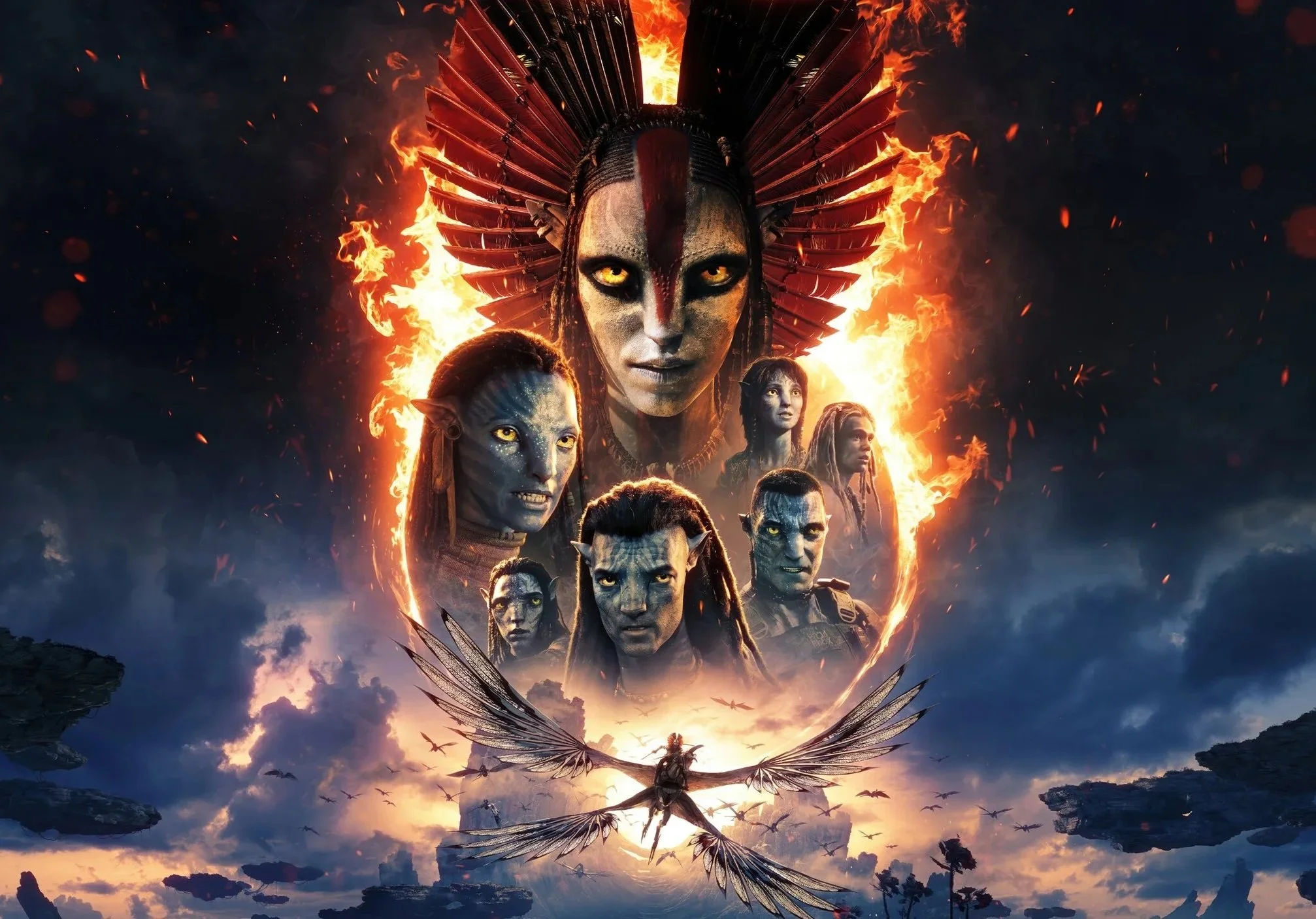
After the scene-setting and (re)introduction to Pandora in Avatar: The Way of Water, Avatar: Fire and Ash focuses more on the characters, their complex relationships with each other, and the emotional fallout from the end of the last film – while still delivering all of the visual spectacle, immersive world-building and epic action that the Avatar series is known for.

Premise: As the Sully family struggle to come to terms with Neteyam’s death, Jake Sully (Sam Worthington) distracts himself with preparation for war, while Neytiri (Zoe Saldaña) is on the brink of being consumed by her grief. But Quaritch (Stephen Lang) is unrelenting in his pursuit of Jake – and of Quaritch’s son, Spider (Jack Champion) – as the RDA’s hunting of the Tulkun intensifies. Into this maelstrom enters Varang (Oona Chaplin) and her Ash clan, ruthless Na’vi raiders who are prepared to do whatever is necessary to ensure their own survival.

Review:
You may or may not know that, originally, James Cameron conceived stories for a second and third Avatar movie, but it quickly became apparent that there was just too much story to squeeze into two films – so the story for the “second chapter” in the saga was split between Avatar: The Way of Water and Avatar: Fire and Ash, while the story for the “final chapter” was split into scripts for a fourth and fifth movie. I say this because, having seen Fire and Ash, it’s clear to see that it really is the “other half” of the story started in The Way of Water, rather than it taking the story in a radial new direction itself. From what I’ve heard, the proposed fourth and fifth films will (if greenlit) expand the canvas further, but for now, Fire and Ash is very much focused on the character fallout from the events of The Way of Water, rather than it attempting to introduce audiences to new cultures or environments in the way that the first two films did.
I must stress, none of this is meant as a criticism – in fact, quite the opposite. Had the Sully family moved to join a new Na’vi clan again, this third film would have felt like to was going over well-trodden ground – and although The Way of Water could (if one was feeling very cynical) be accused of having a very similar plot structure to the original Avatar movie, Fire and Ash for the most part feels like it has a different tone and structure from the previous two movies.
“…Neteyam’s death becomes the emotional cornerstone of the movie…”
Part of this is because the focus in Fire and Ash is very much on the characters and their complex relationships, and less so on introducing audiences to new cultures and environments. A lesser film may have sought to quickly draw a line under the death of Neteyam at the end of The Way of Water, but James Cameron and his writing team make that death the emotional cornerstone of Fire and Ash, and rightly so. Jake Sully (Sam Worthington), ever the soldier, buries his unprocessed emotions as he focuses on practical preparations for the escalating war between the RDA forces and the Na’vi reef clans, but his singlemindedness leaves Neytiri (Zoe Saldaña) to face her grief alone and threatens to irreparably damage his already-strained relationship with his remaining son, Lo'ak (Britain Dalton).
Interestingly, whereas Jake has provided the narration for the first two movies, it’s actually Lo’ak that narrates this third instalment. The intention is clear – the filmmakers want audiences to see the events of Fire and Ash from Lo’ak’s perspective, as he faces external struggles trying to find his place within his grief-stricken family, while also wrestling with his own internal guilt over the part he feels he played in the death of his older brother. Jack and Neytiri are also portrayed as very flawed – but ultimately, very human – protagonists in Fire and Ash, as their grief drives them to make questionable decisions (just as Jake’s fear did in The Way of Water).
“…Stephen Lang is the film’s MVP…”
Most of the returning cast members get plenty of character development to sink their teeth into – for example, Kiri (Sigourney Weaver) is struggling with her feelings of isolation as the only member of the family who’s unable to find solace through a tangible connection to the ancestors via the Spirit Tree, while “Spider” (Jack Champion) is pulled in opposite directions between his connection to the Sully family, and his biological kinship with the resurrected “recombinant” Avatar version of Quaritch (Stephen Lang). For me, Stephen Lang is the film’s MVP, and Quaritch continues to become an intriguingly complex, and somewhat contradictory, character. His love/hate relationship with Jake is explored even further in Fire and Ash – it’s clear that the reason Jake’s “betrayal” hit him so hard is because of the deep-rooted respect that he has for his former corporal, and those conflicting emotions are further complicated here by the mutual bonds they both have with Spider.
At times, the sheer size of the cast does mean that not everyone gets a great deal to do – the youngest Sully child, Tuk (Trinity Jo-Li Bliss), once again gets the least amount of character development, and although Giovanni Ribisi gets a bit more screentime as Selfridge this time around, he and Edie Falco still don’t have much to really get their teeth into as the main RDA representatives. But many in the cast are able to do a lot with a little – Jemaine Clement is only in a couple of scenes, but one of them is arguably the comedic highlight of the film, and Kate Winslet gets a chance to further develop her character Ronal, and especially her antagonistic relationship with Neytiri.
“…Oona Chapin nails the mesmeric physicality of her character…”
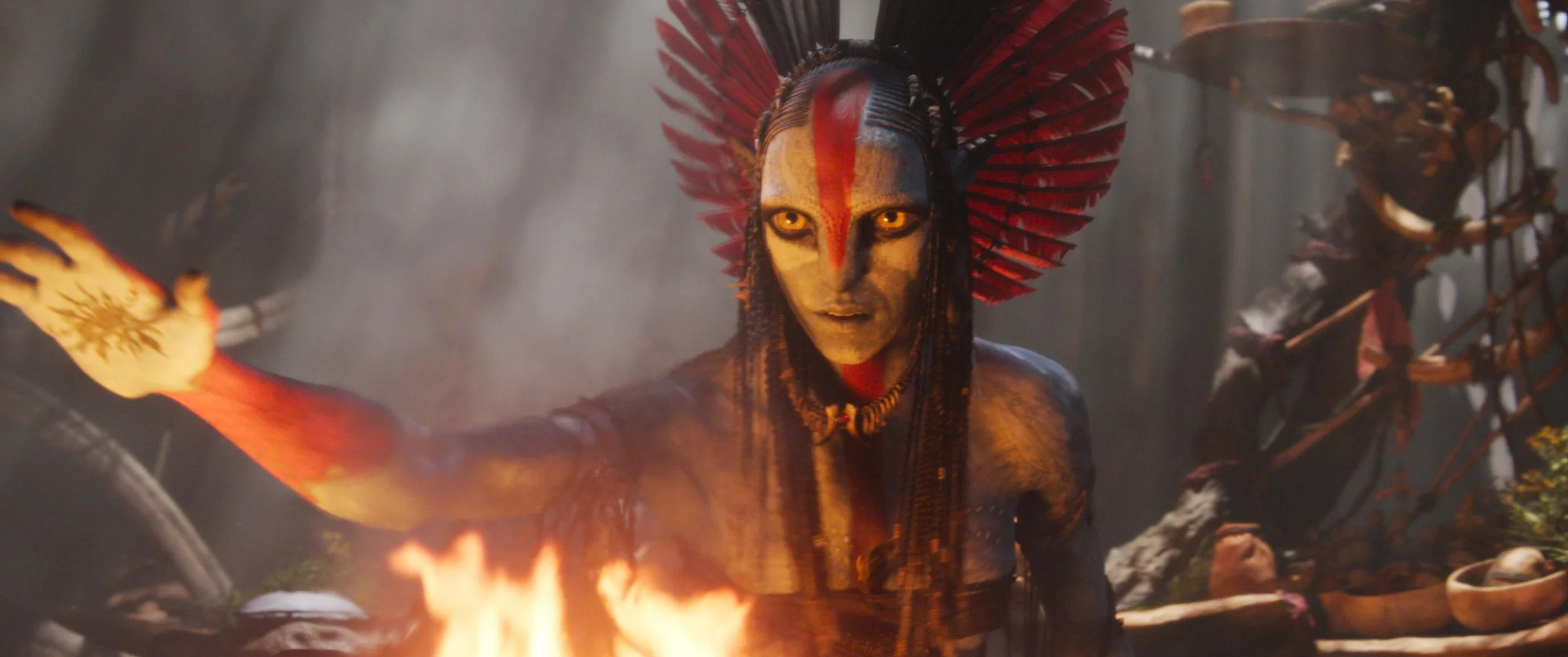
But Fire and Ash very much belongs to ‘the bad guys’, and although Quaritch may be the film’s MVP, he’s given a run for his money by newcomer Varang. Oona Chaplin pretty much steals every scene she’s in, and Varang is an almost hypnotic presence whenever she’s onscreen. Oona Chapin nails the mesmeric physicality of her character, and despite my flippant description of Varang as a ‘bad guy’, one of the things that makes her such a fascinating character is that she’s so much more than that. Yes, she and her Ash clan are brutal and unforgiving – but to an extent, that’s because they come from the brutal and unforgiving environment. Their homeland is a desolate wasteland, where it appears nothing can be grown or hunted, and so the Ash clan have had to resort to raiding other Na’vi tribes in order to survive. It’s easy to see where their ‘kill or be killed’ mentality has come from – but empathy doesn’t make them any less of a formidable adversary. The sequence that introduces Varang and the Ash clan is unrelenting, and one part of that scene (without going into spoiler territory) is particularly chilling.
Speaking of the action sequences, although Fire and Ash spends a lot of its time on character development, when it’s time for action, James Cameron knows how to deliver. There are several standout scenes in the movie that either provide thrilling action sequences or tense moments of jeopardy (Neteyam’s death having established that no one is safe) – and two action sequences in the third act in particular are joyously entertaining. If I was to be really nitpicky, it could be argued that the finale in Fire and Ash is essentially a mash-up of the finales from the first and second films – but even if that is true, this finale is dialled up to eleven and delivers an epic, climactic battle on an unrivalled scale.
“…blends inventive & immersive action sequences with emotion & heart…”
When all is said and done though, epic action alone is not what makes these films standout the way that they do – it’s the blending of the inventive and immersive action sequences with the emotion and heart that comes from the character moments. I can’t lie – there were a number of emotional moments in Fire and Ash that really got to me, and the film’s decision to address weighty emotional themes like grief, hatred and guilt while also tackling important issues like colonialism, environmentalism and genocide is part of the appeal of the series.
None of us have a crystal ball and can predict the future, and I have no idea how much money Fire and Ash needs to make for the fourth and fifth Avatar films to be greenlit – but given that Avatar and Avatar: The Way of Water are already the first and third highest grossing films of all time, I would hope that the fourth and fifth films would be officially greenlit without too long a wait – because as entertaining as Fire and Ash is (and it is very entertaining!), it’s also clear that The Way of Water and Fire and Ash are only (collectively) the middle chapter in the larger story … and I really want to see where that story goes from here.
“…an immersive cinematic experience unlike anything else…”
There will, of course, be some viewers whose aversion to sci-fi means that this sort of film is never going to appeal to them – but by now surely most viewers know whether or not they enjoyed the previous Avatar movies … and if you enjoyed the last two movies, there’s plenty to keep you entertained throughout Fire and Ash, which is certainly an immersive cinematic experience unlike anything else you’ll see this year.